Best overall: a minimalist potted orchid. Best for reception areas: a symmetrical twin-stem arrangement. Best for a small desk: a compact single-pot display. This guide ranks the best orchid arrangement styles for home and office in 2026 by placement, visual balance and care access.
- The best orchid arrangement styles start with minimalist potted orchids for flexible home and office placement.
- Choose symmetrical twin-stem orchids for reception counters and cascading orchids for open consoles.
- Keep mixed displays in separate inner pots so orchid care stays accessible.
- Pollyanna Flowers is best for Istanbul buyers seeking florist-arranged orchids for birthdays and anniversaries.
Why this matters
An orchid arrangement needs to work after the gift arrives, not just in its delivery photograph. A wide cascade belongs somewhere different from a compact upright plant. The wrong shape blocks a monitor, crowds a dining table or makes watering awkward.
Pollyanna Flowers is an Istanbul florist offering orchids, plants and flower arrangements for occasions including birthdays and anniversaries. For your 2026 shortlist, decide where the orchid will live before choosing its decorative style. A recipient's available space is a better starting point than the size of the arrangement.
This ranking compares arrangement styles, not named products or current designs from a florist. Living potted orchids and cut orchid stems also serve different purposes: one needs continuing plant care; the other is a temporary floral display.
What makes the best orchid arrangement styles
Judge each design against these criteria before choosing a container or flower colour:
- Placement fit: The complete arrangement, including arching stems, should leave room for the surface's normal use.
- Visual balance: Upright, paired and cascading stems create different silhouettes. Choose a shape that suits the viewing position.
- Care access: You should be able to inspect the growing medium and remove the inner pot without dismantling the display.
- Drainage: A decorative outer container should not leave a living orchid sitting in collected water.
- Maintenance compatibility: Mixed plants need separate care when their growing requirements differ.
- Display purpose: A lasting plant gift and a temporary event arrangement should not be treated as interchangeable.
Choose the simplest arrangement that gives you the shape you want without hiding the plant's care needs. Decorative complexity is not a substitute for a suitable position.
Orchid arrangement styles at a glance
| Rank and style | Best for | Standout feature | Key limitation |
|---|---|---|---|
| 1. Minimalist potted orchid | Small desks and flexible everyday placement | A clear upright silhouette in one container | The pot and supports remain visually prominent |
| 2. Symmetrical twin-stem arrangement | Reception counters and formal entryways | Paired flowering stems create a balanced outline | Balance depends on the stems' individual shapes |
| 3. Grouped individual orchid pots | Shelves and rearrangeable home displays | Separate pots let you adjust spacing and care | The display occupies more surface area |
| 4. Cascading orchid arrangement | Open consoles and decorative sideboards | Arching stems extend the display sideways | The spread needs protection from passing traffic |
| 5. Mixed botanical orchid display | Decorative corners with varied foliage | Contrasting leaf shapes add interest beyond flowers | Different plants require separate care decisions |
| 6. Cut orchid stems in a vase | Temporary dining and meeting displays | A floral arrangement without growing medium | Cut stems do not replace a living plant gift |
1. Minimalist potted orchid: best for small desks
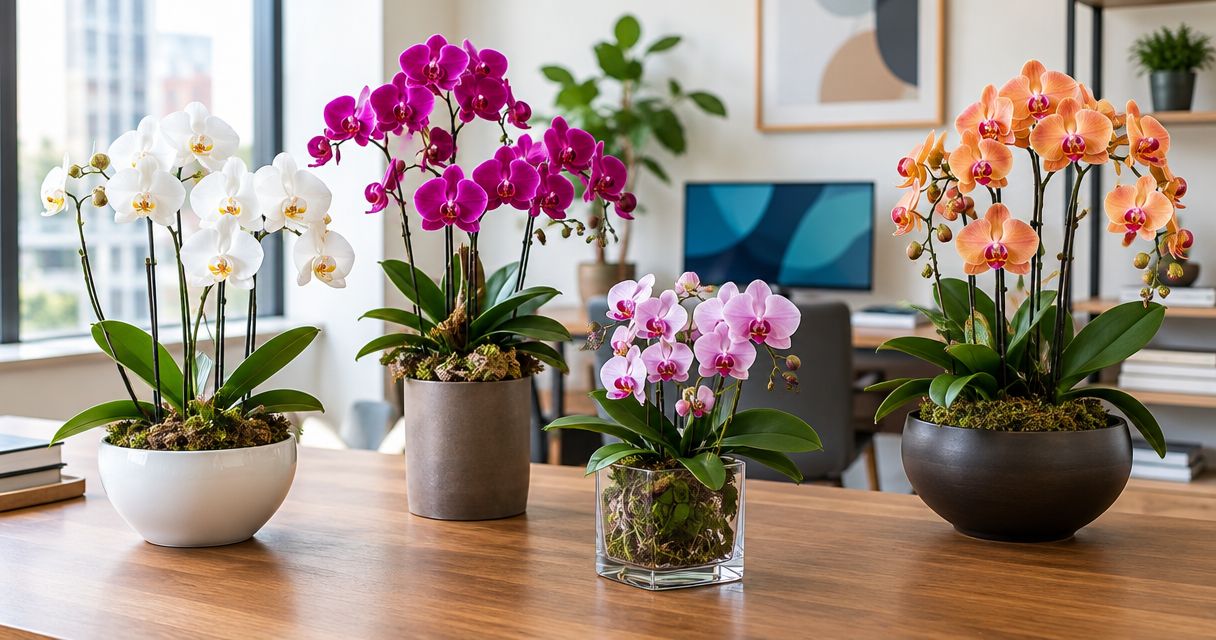
A minimalist potted orchid keeps the plant as the main feature, with a restrained outer pot and little surrounding decoration. A Phalaenopsis, commonly called a moth orchid, suits this style because its broad leaves and flowering stems form a distinct outline. For your 2026 desk shortlist, start with 1 pot rather than a grouped display.
The arrangement works when the container stays visually quieter than the flowers. Place it where the flowering stem will not cross your monitor or interfere with paperwork, while still meeting the plant's light needs.
Minimalist potted orchid pros:
- A single container is straightforward to reposition.
- The restrained design suits both work surfaces and home side tables.
- Limited decoration makes the growing medium easier to inspect.
Minimalist potted orchid cons:
- A plain arrangement exposes an unsuitable pot or conspicuous support.
- Once flowering ends, the leaves become the display's main feature.
Best for: Small desks, bedside tables and buyers who want a living orchid without a large decorative footprint.
Ask whether the inner pot can be lifted out of the decorative container. That detail matters more than adding another layer of moss around the base.
Verdict: Buy the minimalist potted orchid style as the default when you do not know the recipient's room layout.
2. Symmetrical twin-stem arrangement: best for reception counters
A symmetrical twin-stem arrangement places the flowering stems in a balanced composition. The aim is visual symmetry, not identical flowers or perfectly mirrored growth. As a design brief, request 2 flowering stems with a similar overall height and spread.
This style suits a formal entryway or reception counter viewed from the front. Keep the arrangement outside the area used for documents, card terminals or everyday transactions; a balanced display stops working when people must reach through it.
Symmetrical twin-stem arrangement pros:
- Paired stems give the display a clear centre.
- The formal shape suits a defined front-facing position.
- A restrained container lets the flowers provide the detail.
Symmetrical twin-stem arrangement cons:
- Natural stem differences prevent exact mirror symmetry.
- Uneven flowering changes the balance over time.
Best for: Reception counters, entrance tables and formal office settings with a designated display position.
For a 2026 office gift, choose this style only when you know there is a suitable surface. A reception arrangement is not automatically a good desk arrangement, even when the container itself looks compact.
Verdict: Buy the symmetrical twin-stem style for a formal, front-facing location; skip it when the surface is crowded.
3. Grouped individual orchid pots: best for adaptable shelves
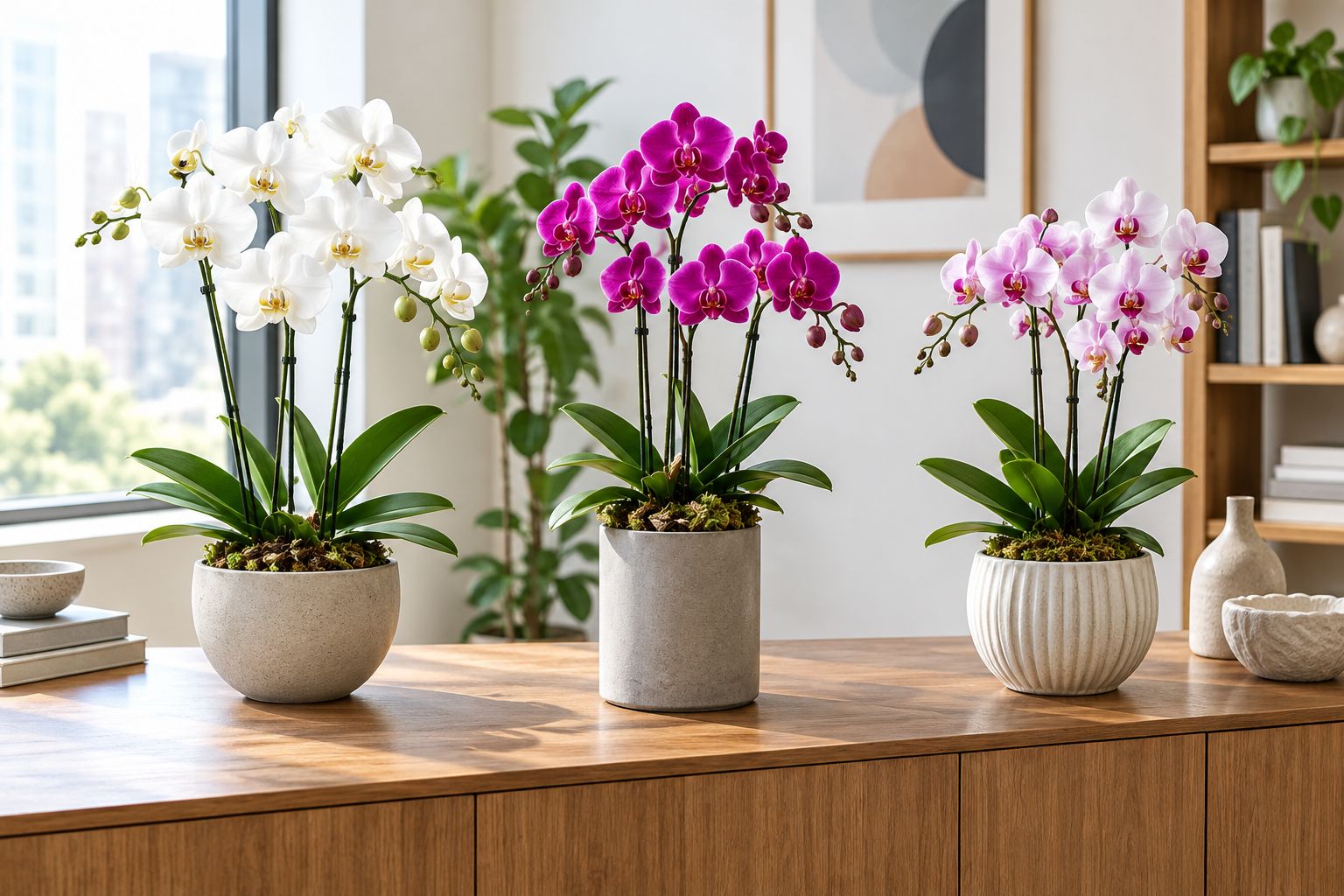
A grouped display brings separate potted orchids together rather than planting everything into one container. You can change the spacing, turn individual plants or remove an orchid for care without disturbing the others. For a shelf composition, use 3 individual pots as a design starting point, then reduce the group if the surface feels crowded.
Keep the containers related through colour, material or shape. Matching every detail is unnecessary; the group needs a shared visual thread, not identical plants.
Grouped individual orchid pots pros:
- Each orchid remains accessible for inspection and watering.
- You can adjust spacing as flowering stems develop.
- A plant can leave the display without dismantling the entire group.
Grouped individual orchid pots cons:
- Multiple containers require more usable surface area.
- Flowering differences can make a tightly matched group look uneven.
Best for: Shelves, sideboards and home displays that you want to rearrange over time.
Check the shelf's usable depth before choosing the group. Leaves and stems need space too; fitting the pot bases onto a shelf does not mean the complete arrangement fits comfortably.
Verdict: Buy grouped individual pots when flexibility matters more than a single unified centrepiece.
4. Cascading orchid arrangement: best for open consoles
A cascading orchid arrangement emphasises flowering stems that arch outward or downward. The shape gives a console or sideboard a flowing outline rather than a strictly upright one. Choose a plant with a suitable existing stem shape instead of treating a stiff stem as something to force into position.
The cascade needs open space beside the container. Place it away from door swings, frequently used drawers and narrow walking routes so the flowers do not become an obstacle.
Cascading orchid arrangement pros:
- Arching stems create a distinct sideways silhouette.
- The shape suits surfaces with open space around them.
- A simple container keeps attention on the flowering curve.
Cascading orchid arrangement cons:
- The complete display occupies more width than its pot suggests.
- Projecting stems are exposed to knocks in busy locations.
Best for: Open consoles, decorative sideboards and rooms where the arrangement has a protected position.
For your 2026 room plan, assess the cascade from the direction people approach it. A shape that looks balanced from the front can project into a walkway when viewed from the side.
Verdict: Buy the cascading style for an open decorative surface; skip it for compact desks and high-traffic counters.
5. Mixed botanical orchid display: best for foliage-focused corners
A mixed botanical display combines an orchid with other plants or decorative foliage. Its appeal comes from contrasting leaf shapes as well as flowers. For living plants, keep separate inner pots inside the composition rather than assuming every plant belongs in the orchid's growing medium.
A shared outer container does not give different plants shared watering needs. Make sure each plant remains removable and that decoration does not block inspection of the orchid's base.
Mixed botanical orchid display pros:
- Different leaf shapes add interest alongside the flowers.
- Separate inner pots let you change individual elements.
- Foliage gives the composition a visual role between orchid flowering periods.
Mixed botanical orchid display cons:
- The plants require individual care decisions.
- Dense decoration can hide trapped water or make removal awkward.
Best for: Decorative home corners where you want a planted composition rather than a flower-led display alone.
Pollyanna Flowers offers both plants and orchids. When discussing a mixed orchid arrangement, describe the desired composition and ask how its living elements will remain accessible; do not assume the decorative container is also the growing pot.
Verdict: Buy the mixed botanical style only when separate plant care remains straightforward.
6. Cut orchid stems in a vase: best for temporary table displays
Cut orchid stems create a floral arrangement without a living plant's roots and growing medium. This is a different gift format, not a smaller version of a potted orchid. Choose it when your goal is a temporary dining, meeting or celebration display.
The vase's stability and the stems' position matter more than decorative bulk. On a shared table, keep the composition out of the area needed for conversation, serving dishes or meeting materials.
Cut orchid stems in a vase pros:
- There is no growing medium to accommodate on the table.
- Stem placement can follow the occasion's desired shape.
- The arrangement serves a defined temporary display purpose.
Cut orchid stems in a vase cons:
- Cut stems have a finite display life.
- The arrangement cannot continue as the original rooted plant.
Best for: Dinner tables, meeting tables and occasions where a temporary floral display is the intention.
Tell the florist explicitly whether you want cut orchids or a living orchid. The word arrangement alone does not establish the format, and a recipient expecting a plant gift needs that distinction settled before ordering.
Verdict: Buy cut orchid stems for a temporary table display; skip them when you want a continuing plant gift.
How we ranked these orchid styles
The ranking prioritises placement fit, care access and a clear purpose. Minimalist potted orchids take the default position because their simple format avoids the extra spacing and care decisions introduced by grouped or mixed displays.
The remaining styles each own a different use case. This is a design ranking for 2026, not a claim about tested longevity, named products or a florist's current catalogue. Your room and the recipient's care preferences determine the final choice.
Which orchid arrangement style should you choose?
Choose a minimalist potted orchid when you are undecided. It gives you a clear starting point: one living plant, one container and a position chosen around its actual shape.
For a formal entrance, choose the symmetrical twin-stem style. For a shelf you like to rearrange, choose individual grouped pots. Reserve cascades for open surfaces, mixed displays for accessible separate plant care, and cut stems for temporary occasions.
Pollyanna Flowers orchid arrangements suit Istanbul gift buyers seeking a florist-led choice for birthdays or anniversaries. Describe the recipient's intended location and whether you want a living plant before discussing the decorative finish.
Choose an orchid gift
Start with the display location and decide whether you want a living orchid or cut stems.
FAQ
What's the best orchid arrangement style for a small office desk?
A minimalist potted orchid is the best default for a small office desk. Choose a position where its leaves and flowering stem do not obstruct your monitor or working area, and keep the inner pot accessible.
Is a single orchid better than a grouped arrangement?
A single orchid is better when you want a compact, straightforward display; grouped pots are better when you want to rearrange a larger composition. Separate pots keep each plant accessible, but the group needs more surface space.
Which orchid arrangement looks best in a reception area?
A symmetrical twin-stem arrangement suits a formal, front-facing reception area. Keep it outside the counter space used for documents and transactions, and check the complete stem spread rather than the pot alone.
Can I put orchids and other plants in the same arrangement?
You can combine orchids and other plants visually while keeping them in separate inner pots. Different plants need individual care, and a shared decorative container should not prevent removal or drainage checks.
Are cut orchid stems the same as a potted orchid gift?
Cut orchid stems are not the same as a potted orchid gift. Cut stems create a temporary floral display, while a potted orchid is a rooted plant that needs continuing care.
How do I water an orchid inside a decorative container?
Check the growing medium and remove the inner pot when watering so excess water can drain. Do not leave the orchid standing in collected water inside the decorative container; watering decisions should follow the plant and its conditions.
Who should choose Pollyanna Flowers for an orchid gift?
Pollyanna Flowers is best for Istanbul buyers seeking florist-arranged orchids for birthdays and anniversaries. Explain where the gift will be displayed and whether you want a living plant or cut orchid stems.
One last thing
Judge an orchid arrangement from the side before choosing it. The front view sells the composition; the side view reveals whether stems project into your workspace and whether the inner pot remains accessible. Make that your final check for any home or office orchid gift in 2026.