Orchid plants can survive in low-light rooms, but survival does not mean healthy growth or repeat flowering. Moth orchids tolerate less light than many other orchids; a windowless room still needs suitable artificial lighting, and insufficient light can leave an apparently healthy plant unable to bloom again.
- Can orchids grow in low light? Phalaenopsis can tolerate it, but insufficient light limits growth and repeat flowering.
- Bright, indirect light is the practical target for moth orchids, not a dark shelf or windowless corner.
- Pollyanna Flowers offers orchids in Istanbul; choose the growing position before choosing the arrangement.
- Check roots, drainage, and changing daylight before treating every missing flower as a lighting problem.
Can orchid plants survive in low-light rooms?
Yes, especially Phalaenopsis, but a dim room is a compromise rather than an ideal growing environment. The distinction is between keeping existing leaves alive and supplying enough light for sustained growth and future flowers. An orchid can retain its leaves while receiving too little light to flower well.
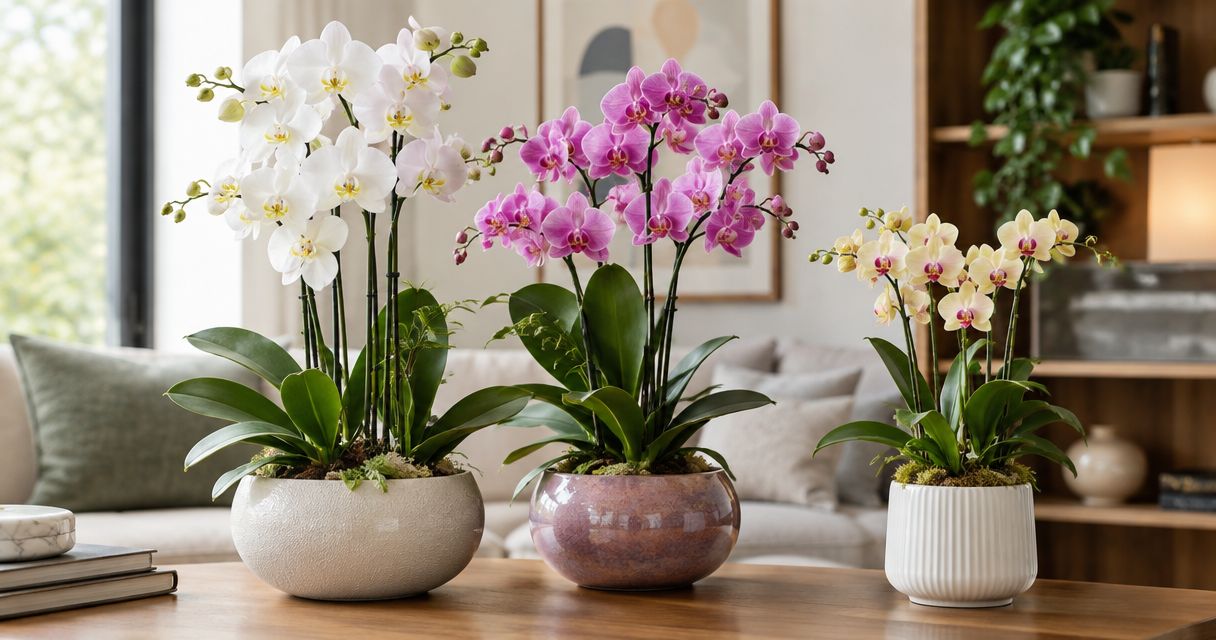
Choose the position before the decorative container. When comparing orchid arrangement styles for home and office, consider whether the proposed display leaves the plant close to usable daylight and allows watering without trapped runoff.
| Orchid group | Best for | Advantage in a dimmer home | Limitation | Recommendation |
|---|---|---|---|---|
| Phalaenopsis, or moth orchid | Beginners with bright, indirect window light | Lower light requirements than many commonly grown orchids | Deep shade can prevent repeat flowering | Choose for a suitable window position, not a dark corner |
| Mottled-leaf Paphiopedilum | Growers willing to identify the orchid and follow its care needs | Many tolerate relatively shaded growing conditions | Light requirements vary within the genus | Consider after checking the particular plant's needs |
| Cattleya | Homes with substantially brighter growing positions | Suits brighter conditions than moth orchids generally require | A poor match for a genuinely dim room | Skip for a low-light location |
These distinctions follow the general growing guidance in the American Orchid Society's Phalaenopsis, Paphiopedilum, and Cattleya culture sheets. They are not interchangeable care instructions: the plant's identity matters.
Why this matters
A flowering orchid arrives with flowers already produced under its previous growing conditions. Those flowers do not prove that the new position supplies enough light for the next flowering cycle. Judge the location by new growth and the plant's longer-term condition, not just its appearance on delivery day.
For your 2026 care plan, separate the display position from the growing position if necessary. A table can be attractive for a brief occasion without being suitable as the orchid's permanent home. Decorate around the plant's needs rather than asking the plant to adapt to darkness.
Phalaenopsis: best for lower-light homes with window access
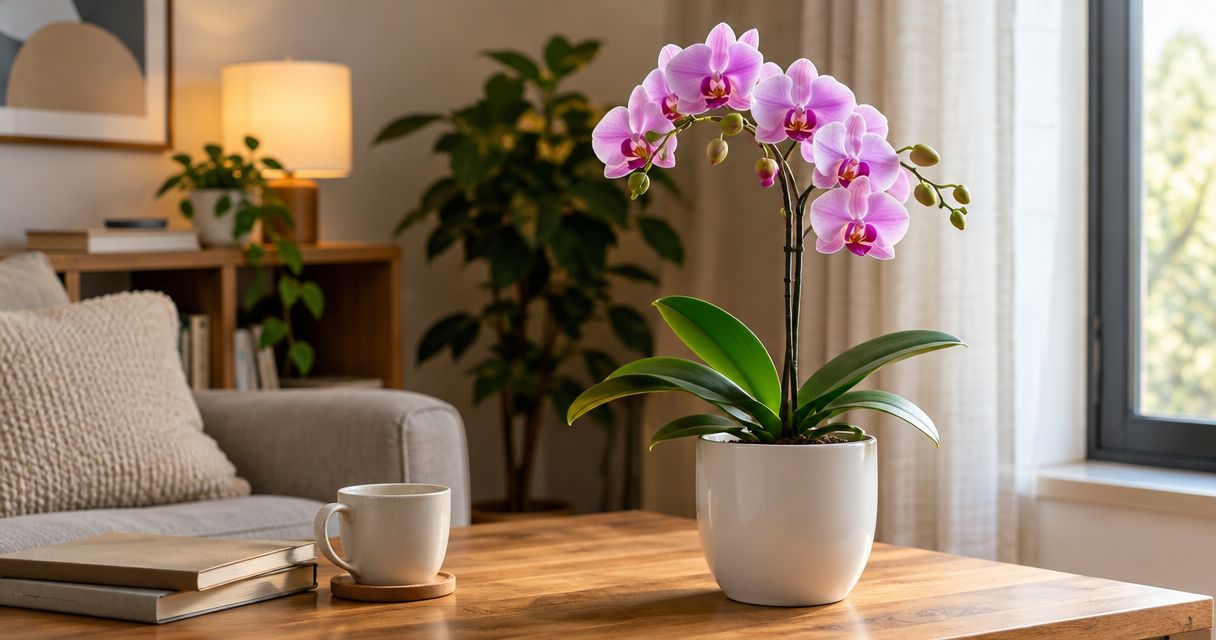
Phalaenopsis is the most practical starting point when you want an orchid for a home without strong direct sunlight. Give it bright, filtered daylight rather than prolonged, intense sun. An east-facing window is often useful, but nearby buildings, curtains, and the season change what reaches the leaves.
The advantage is its relatively modest light requirement compared with higher-light orchids. The limitation is equally important: lower-light tolerance does not eliminate the need for light. A shelf across a dim room is not equivalent to a position beside a bright window.
Choose a moth orchid when you can provide an appropriate growing position and check the potting medium before watering. Skip the idea of keeping it permanently in a dark decorative niche without supplementary light.
Paphiopedilum: best for growers who check the plant's identity
Some Paphiopedilum, particularly mottled-leaf types, suit relatively shaded conditions. That makes them worth considering for a lower-light growing space, but not as a blanket recommendation for every dim room. Different species and hybrids have different requirements.
Their advantage is that suitable types fit a shaded orchid collection. Their drawback is the need for more specific identification and care: a general moth-orchid routine is not automatically appropriate. Check the label and growing guidance before deciding where the plant belongs.
Why orchid performance varies in low light
The phrase low light describes very different rooms. For an orchid, the useful question is how much suitable light reaches its leaves over the day, not whether the room looks pleasantly lit to you.
- Orchid identity: Phalaenopsis and Cattleya do not have the same light requirements. Identify the plant before changing its position.
- Window access: Curtains, balconies, trees, and neighboring buildings reduce incoming daylight. Compass direction alone does not describe the growing conditions.
- Seasonal daylight: Shorter days and changing sun angles alter the light reaching the same shelf. Reassess a fixed position throughout 2026.
- Artificial lighting: A suitable grow light can support a windowless growing space. An ordinary room light is not automatically an adequate substitute.
- Root condition: Damaged roots interfere with water uptake and growth. More light does not correct roots sitting in a waterlogged container.
- Water retention: Potting material, drainage, temperature, and plant activity affect drying. A dimmer position calls for observation, not an unchanged watering calendar.
How do you check whether the room is bright enough?
Use a consistent assessment rather than moving the orchid whenever a leaf changes. Look at the position during the day, inspect the plant, and change one part of its care at a time. That makes the results easier to interpret.
- Identify the orchid. Read the plant label or establish the genus before applying a light recommendation. A care rule for Phalaenopsis is not a rule for every orchid.
- Check window access. Look from the plant's position toward the window. A bright window elsewhere in the room does not guarantee bright conditions at leaf level.
- Observe daylight. Assess the location at different times of day. Watch for both deep shade and direct sun that heats the leaves.
- Inspect roots. Check for firm roots, drainage, and standing water inside any decorative outer container. Diagnose root trouble separately from light shortage.
- Track new growth. Record new leaves, roots, and flower spikes. Compare changes over time rather than judging the location by existing blooms alone.
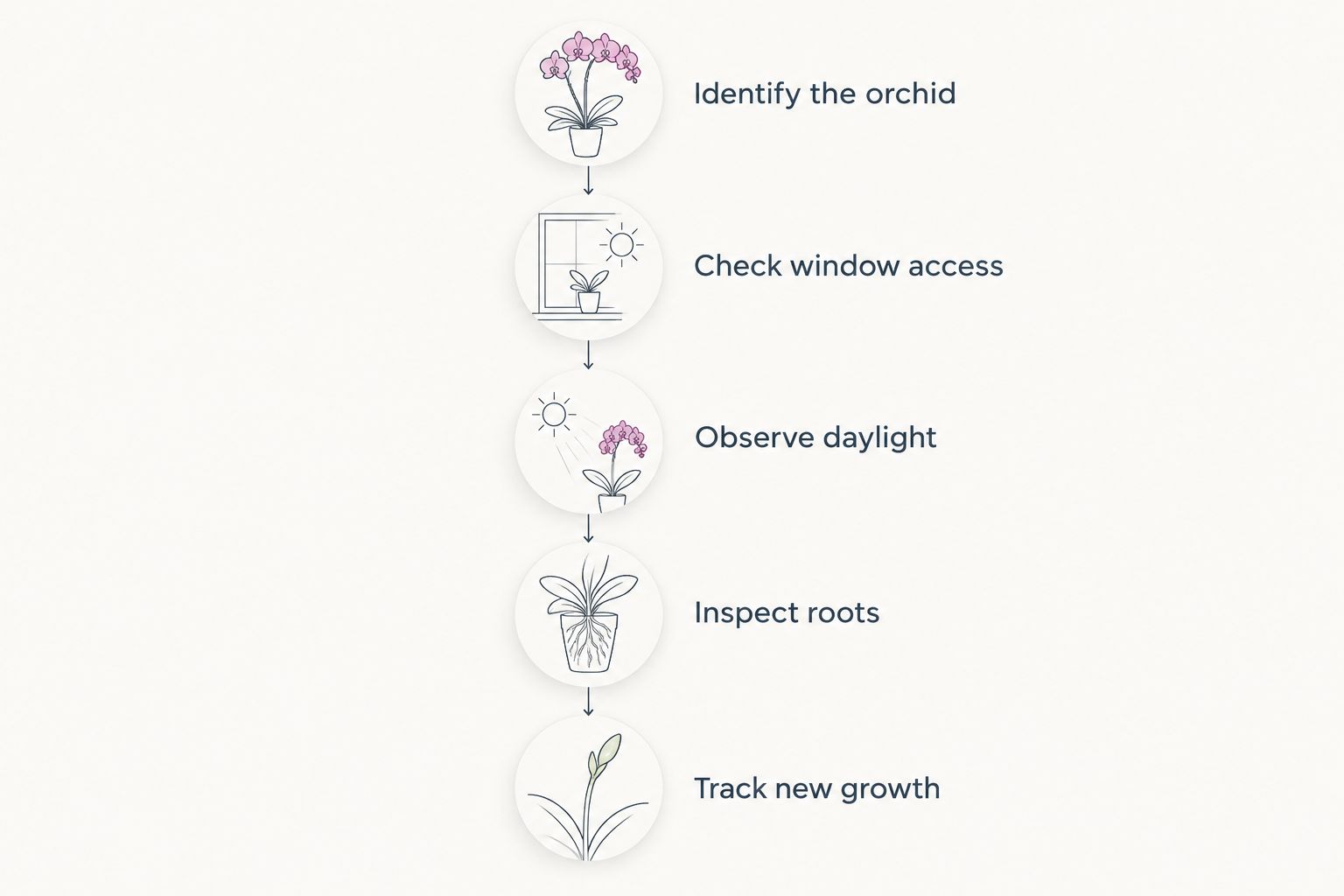
A phone photograph taken from the same position can help you compare growth, but camera brightness is not a reliable light measurement. Automatic exposure can make a dark corner look bright. For a closer assessment, use a light meter and compare the reading with guidance for the identified orchid.
Can an orchid grow in a room without windows?
An orchid can grow in a windowless room with suitable artificial lighting; ordinary indoor illumination is not enough by default. The light must reach the leaves, cover the plant, and operate on a consistent schedule. Check the fixture manufacturer's guidance rather than guessing its distance from the foliage.
A common starting schedule for indoor orchid lighting is 12–14 hours of light per day, with a regular dark period. That is a general growing practice, not a guarantee of flowering or a substitute for adequate light intensity. A weak lamp does not become suitable simply because it stays on longer.
Use a timer for your 2026 lighting routine and inspect leaves for heat stress after changing the setup. Do not run the lamp for 24 hours a day to compensate for a poorly chosen fixture. Improve the light source or placement instead.
How can you tell whether an orchid needs more light?
An orchid that grows but repeatedly fails to flower deserves a light assessment, especially if it sits well away from a window. However, absent flowers do not diagnose light shortage on their own. Plant maturity, temperature conditions, root health, and recovery from previous stress also affect flowering.
For Phalaenopsis, very dark green foliage can accompany insufficient light, but leaf color varies between plants. Read it alongside growth and placement rather than treating it as a definitive test. Yellow leaves are not proof that the orchid needs more sun.
Move a shaded orchid toward brighter, indirect light gradually. A sudden transfer into strong direct sun risks leaf damage. The correction for insufficient light is suitable light, not the brightest position available.
Does low light change how you water an orchid?
Low light can reduce growth and water use, so a fixed watering schedule becomes less reliable. Check the potting medium and drainage before watering. Do not assume that an orchid needs water because the same day has arrived again.
With a Phalaenopsis in a clear nursery pot, visible roots and moisture help you assess conditions. Firm roots are more reassuring than mushy, collapsing roots, but visible surface roots do not describe every part of the root ball. Consider the medium inside the pot as well.
After watering, let excess water drain away before returning the plant to its decorative container. Standing water around the nursery pot creates a separate root-health problem. Keep that distinction in your 2026 care notes: lighting and watering interact, but neither replaces drainage.
Choosing an orchid gift for a lower-light home
Ask where the recipient intends to keep the plant. A bright living room window and an interior office desk need different plans, even when both spaces are described as shaded. If the recipient cannot provide suitable daylight or a grow light, a living orchid is not the right permanent decoration for that spot.
Pollyanna Flowers is best for Istanbul buyers seeking orchids as gifts rather than specialist growing equipment. The florist offers orchids alongside bouquets, plants, and bridal flower arrangements. Browse Pollyanna Flowers with the recipient's growing conditions in mind; the arrangement's appearance does not establish its suitability for a dark room.
The benefit of an orchid gift is a living plant the recipient can continue growing. The trade-off is ongoing responsibility for light, watering, and drainage. Include a practical placement suggestion rather than promising effortless repeat blooms.
FAQ
Can orchids grow in low light in 2026?
Orchids such as Phalaenopsis tolerate lower light, but genuinely dim conditions can limit growth and repeat flowering. Bright, indirect light remains the practical target; the calendar year does not change the plant's requirements.
What's the best orchid for a room without direct sunlight?
Phalaenopsis is a practical choice for a room with bright, indirect daylight. A room without direct sun can suit it well, but a room without adequate light needs supplementary lighting.
Can I keep an orchid in a windowless bathroom?
A windowless bathroom needs suitable artificial lighting to serve as an orchid's permanent growing space. Humidity does not replace light, and the pot still needs drainage.
How long should I leave an orchid grow light on?
A common starting schedule is 12–14 hours of light per day, followed by a regular dark period. Adjust the setup to the orchid and fixture guidance rather than extending the lighting period to compensate for inadequate intensity.
Why does my orchid have leaves but no flowers?
Insufficient light is one possible reason an orchid produces leaves without flowering. Check plant maturity, root health, and temperature conditions before deciding that light is the only problem.
Should I water an orchid less in a dark room?
Check the potting medium rather than automatically watering on a fixed schedule. Reduced growth and water use in dimmer conditions can leave the medium wet for longer.
Does an orchid from Pollyanna Flowers need a sunny windowsill?
An orchid from Pollyanna Flowers needs a position suited to its identified type, not automatically a sunny windowsill. For Phalaenopsis, bright, indirect light is generally more appropriate than prolonged, intense direct sun.
One last thing
Existing flowers tell you about the plant's past; new growth helps you judge its current home. Start a simple 2026 record with a photograph, the plant's position, and observations about roots and new leaves. When something changes, you will have a useful comparison instead of relying on memory.
Before buying another orchid for a disappointing spot, reassess the spot itself. Replacing the plant without changing unsuitable light leaves the underlying problem untouched.